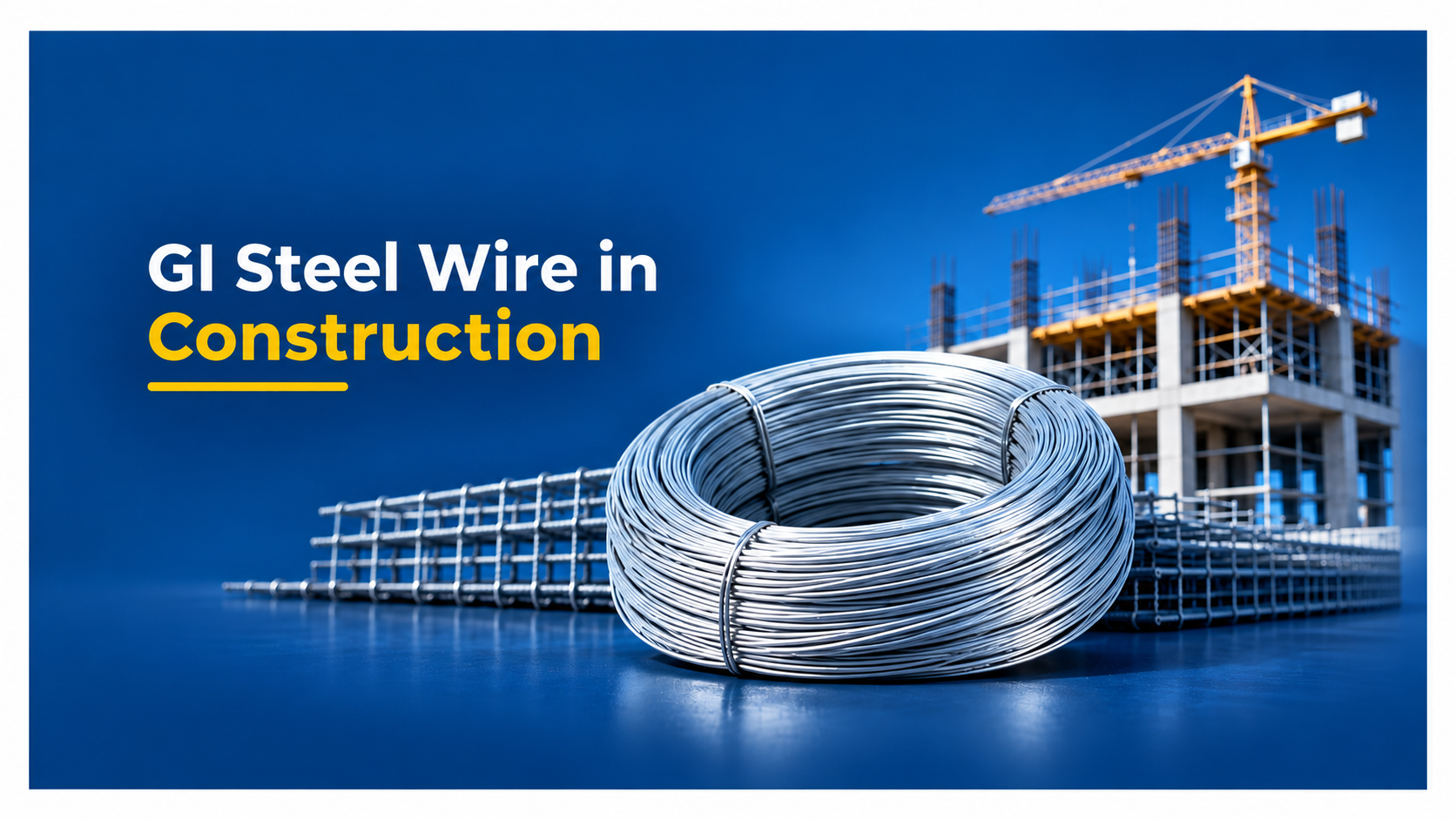
The strength and durability of a construction project depend on the quality of the materials used at every stage. From structural components and reinforcement systems to fencing and infrastructure installations, selecting suitable materials is essential for achieving reliable performance. One material widely used across construction and industrial applications is GI steel wire in construction.
GI steel wire, also known as galvanised iron wire or galvanised steel wire, is manufactured by coating steel wire with a protective layer of zinc. This coating helps protect the underlying steel from corrosion, making it suitable for applications where exposure to moisture and outdoor environmental conditions is a concern.
In this guide, we explore the major applications, benefits, and selection guidelines for GI steel wire in construction.
What Is GI Steel Wire?
GI steel wire is a steel wire coated with zinc through a galvanization process. The zinc coating acts as a protective barrier and provides sacrificial corrosion protection, helping reduce rust formation when the wire is exposed to moisture and environmental conditions.
Two commonly used galvanization processes are
Hot-dip galvanization: Steel wire passes through molten zinc to develop a protective coating. The coating thickness depends on the manufacturing process and specified requirements.
Electro-galvanization: Zinc is deposited onto the steel wire through an electrochemical process, generally producing a thinner and more controlled coating.
Hot-dip galvanised wire is commonly considered for applications requiring enhanced corrosion protection, while electro-galvanised wire may be suitable for selected general-purpose applications.
The choice depends on the intended use, environmental exposure, mechanical requirements, and applicable product standards.
Major Applications of GI Steel Wire in Construction
GI steel wire is used in residential, commercial, industrial, and infrastructure projects. Its corrosion resistance, mechanical properties, and availability in different specifications make it suitable for several construction-related applications.
1. Binding and Tying Applications
GI steel wire can be used for various binding and fastening requirements on construction sites. Depending on its diameter, flexibility, and finish, it may be used to secure construction materials, mesh components, and other assemblies.
Common applications include:
Securing selected construction materials.
Tying wire mesh and fabricated components.
Fastening fencing and support arrangements.
General-purpose binding and site applications.
The wire specification should match the intended fastening requirement. For example, conventional annealed binding wire may be more appropriate where greater flexibility is required.
2. Fencing and Boundary Protection
Fencing is important for securing construction sites, industrial facilities, commercial properties, and agricultural land. GI steel wire is commonly used in fencing products because its zinc coating helps protect against outdoor corrosion.
Applications include:
Construction site boundary fencing.
Industrial security fencing.
Agricultural and perimeter fencing.
Chain-link fencing.
Wire mesh panels and enclosures.
For outdoor fencing, manufacturers and contractors should consider wire diameter, tensile strength, zinc coating quality, and exposure to moisture.
3. Wire Mesh Manufacturing
GI steel wire is widely used in the production of wire mesh for construction, industrial, and infrastructure applications.
Depending on the product design, galvanized wire mesh can be used for protective barriers, partitions, enclosures, and selected reinforcement-related applications.
Common products include:
Welded wire mesh.
Chain-link fencing.
Protective mesh panels.
Industrial partitions.
Selected gabion and containment products.
The suitability of GI wire depends on the mesh design, loading requirements, corrosion exposure, and applicable product specifications.
4. Gabion Baskets and Retaining Structures
Gabion baskets are wire mesh containers filled with stones or other suitable materials. They are commonly used in infrastructure and landscaping projects for erosion control, slope protection, drainage channels, and retaining structures.
Galvanized steel wire can be used in gabion manufacturing to help protect the mesh against corrosion. In environments with high moisture or aggressive soil conditions, selecting the appropriate zinc coating specification is particularly important.
The wire diameter, mesh opening, coating quality, and structural design should meet the requirements of the intended application.
5. Cable Protection and Infrastructure Applications
GI steel wire is also used in selected electrical and infrastructure-related products. Depending on the product design, galvanized steel wires may be incorporated into cable armoring, support arrangements, and utility-related components.
These applications require purpose-designed wire with the appropriate mechanical properties and coating specifications. General-purpose GI wire should not be substituted for specialized cable armoring or engineered support wire.
Key Benefits of Using GI Steel Wire in Construction
The popularity of GI steel wire comes from its combination of corrosion protection, mechanical performance, versatility, and ease of handling.
1. Improved Corrosion Resistance
The zinc coating helps protect the underlying steel from rust and environmental corrosion. This makes GI steel wire useful in applications where untreated steel wire may deteriorate more quickly due to moisture exposure.
The actual corrosion resistance depends on coating thickness, coating uniformity, environmental conditions, and maintenance.
2. Durability and Long-Term Performance
Properly manufactured GI steel wire can provide reliable performance across various construction applications. Its protective coating helps maintain the condition of the underlying steel, particularly in outdoor installations.
Selecting the correct coating specification is essential for achieving the expected service life.
3. Flexibility and Ease of Handling
GI steel wire is available in different diameters and mechanical grades. This allows manufacturers and contractors to select products with the required balance of flexibility and strength.
Depending on the specification, the wire can be cut, shaped, twisted, or incorporated into mesh and fencing products.
4. Versatility Across Industries
GI steel wire is used in residential, commercial, industrial, and infrastructure projects. It can be manufactured into different forms and supplied in coils or other configurations to meet specific requirements.
Alongside galvanized steel products, other engineered materials also contribute to modern construction and industrial applications. Explore how synthetic fibers support innovation and strength in modern application.
5. Cost-Effective Material Selection
GI steel wire can be a cost-effective choice when its initial price is evaluated alongside corrosion protection, maintenance requirements, and expected service life.
However, the lowest-priced wire is not necessarily the most economical option. Inadequate coating or inconsistent mechanical properties may result in premature deterioration and replacement costs.
Types of GI Steel Wire Used in Construction
Different types of GI steel wire are available depending on the galvanization process, mechanical properties, and intended application.
Type | Key Characteristics | Common Applications |
Hot-dip galvanised wire | Zinc coating applied through molten zinc | Outdoor fencing, mesh, and selected infrastructure applications |
Electro-galvanized wire | Zinc deposited through an electrochemical process | Selected indoor and general-purpose applications |
GI binding wire | Available in suitable diameters and finishes for tying | Construction binding and fastening |
High-tensile GI wire | Manufactured to meet specified tensile requirements | Selected fencing and engineered wire applications |
GI stranded wire | Multiple galvanized wires combined into strands | Selected support and infrastructure applications |
The appropriate type should be selected according to the intended use rather than relying only on the product name.
How to Choose the Right GI Steel Wire for Construction
Selecting the right GI steel wire is important for ensuring product performance, durability, and compliance with project specifications. Consider the following factors before purchasing.
1. Check the Wire Diameter
Wire diameter influences material weight, handling characteristics, and mechanical performance. Thicker wire may be required for certain fencing or mesh applications, while thinner wire may be suitable for selected binding and fastening requirements.
Always confirm the required diameter and dimensional tolerance before placing an order.
2. Evaluate Zinc Coating Quality
The zinc coating is one of the most important factors influencing the corrosion resistance of GI steel wire.
Check the specified coating mass or thickness, coating uniformity, adhesion, and surface finish. For outdoor or demanding environments, choose a product with a coating specification suitable for the expected exposure.
3. Consider Tensile Strength
Tensile strength indicates the maximum tensile stress a wire can withstand before breaking. Different applications require different mechanical properties.
For example, binding applications may require suitable flexibility, whereas fencing and selected infrastructure products may require higher tensile performance.
Elongation and bending behavior should also be considered alongside tensile strength.
4. Verify Manufacturing Quality and Standards
The manufacturing quality of GI steel wire directly influences its strength, durability, surface finish, and corrosion resistance. Before purchasing, it is important to evaluate the consistency of the manufacturing process and the quality of the finished product.
Consider checking the following parameters:
Wire diameter consistency: Ensure the wire maintains uniform thickness throughout the coil.
Zinc coating uniformity: Check whether the galvanised coating is evenly distributed across the wire surface.
Coating adhesion: Verify that the zinc coating adheres properly to the steel and does not peel or flake during normal handling.
Tensile strength: Confirm that the wire meets the required strength specifications for its intended application.
Surface finish: Inspect the wire for visible defects, irregularities, excessive roughness, or coating damage.
Batch consistency: Check whether different production batches maintain consistent dimensions, coating quality, and mechanical properties.
Choosing a manufacturer with established quality control procedures and reliable testing facilities can help ensure that the supplied GI steel wire meets the required project specifications.
5. Match the Wire to Environmental Conditions
The operating environment influences the required coating and material specifications.
Indoor applications: May have relatively limited exposure to moisture.
Outdoor fencing: Requires consideration of rain, humidity, and environmental exposure.
Coastal environments: May expose wire to more aggressive corrosive conditions.
Industrial environments: May involve chemical exposure and other demanding conditions.
Soil-contact applications: Require careful assessment of corrosion risks.
Selecting the correct coating specification helps improve product performance under the expected operating conditions.
Why Quality Standards Matter When Purchasing GI Steel Wire
Quality consistency is essential when GI steel wire is used in construction and infrastructure applications. Differences in wire diameter, tensile properties, and zinc coating can affect the performance of the finished product.
Before purchasing, consider checking:
Wire diameter and dimensional tolerance.
Tensile strength and elongation.
Zinc coating mass and uniformity.
Coating adhesion.
Surface defects and finish.
Batch identification and traceability.
Relevant inspection and test certificates.
For construction projects, material selection should also be considered alongside other performance-focused materials. For example, concrete reinforcing fibers for improving concrete strength and durability.
Conclusion
GI steel wire in construction plays an important role in binding, fencing, wire mesh manufacturing, gabion structures, and selected infrastructure applications. Its zinc coating provides corrosion protection, while its availability in different diameters and mechanical grades makes it adaptable to a wide range of project requirements.
Choosing the right product requires more than comparing prices. Wire diameter, tensile strength, zinc coating quality, manufacturing consistency, environmental exposure, and applicable standards should all be considered before purchasing.
For construction contractors, infrastructure developers, and wire product manufacturers, working with a reliable supplier and verifying product specifications can help ensure consistent quality and dependable performance.
Explore synthetic fiber & monofilament expertsto learn more about product specifications and available solutions for industrial and construction-related requirements.
Frequently Asked Questions (FAQs)
1. What is GI steel wire used for in construction?
GI steel wire is used for binding and fastening, fencing, wire mesh manufacturing, gabion baskets, and selected infrastructure applications. Its zinc coating helps protect the steel from corrosion.
2. What is the difference between GI wire and normal steel wire?
Normal steel wire does not necessarily have a protective zinc coating, whereas GI steel wire has a zinc layer that helps reduce corrosion. This makes GI wire suitable for applications where exposure to moisture and outdoor conditions is a concern.
3. Is hot-dip GI wire better than electro-galvanized wire?
Hot-dip galvanised wire generally offers a thicker zinc coating and is often selected for applications requiring greater corrosion protection. Electro-galvanized wire typically has a thinner coating and may suit selected less demanding applications. The best option depends on the required coating specification and service environment.
4. How do I select the right GI steel wire for a construction project?
Consider the wire diameter, tensile strength, zinc coating, flexibility, environmental exposure, and relevant product standards. Also verify the manufacturer's test certificates and ensure that the supplied wire meets the project specifications.
5. How can I identify good-quality GI steel wire?
Good-quality GI steel wire should have a uniform zinc coating, consistent wire diameter, a smooth surface finish, and the required tensile strength. Check the coating adhesion, inspect for visible defects, and request product specifications and quality test reports from the manufacturer before purchasing.