Choosing the right galvanised iron (GI) steel wire is essential for achieving durability, strength, and reliable performance in construction, fencing, wire mesh manufacturing, and industrial applications. However, selecting GI steel wire involves more than comparing prices or choosing a particular thickness. Factors such as wire diameter, tensile strength, zinc coating, and manufacturing quality directly influence its suitability for different applications.
GI steel wire is manufactured by coating steel wire with zinc to improve its resistance to corrosion. It is available in different diameters, mechanical grades, and coating specifications to meet specific application requirements.
Whether you are a construction contractor, wire mesh manufacturer, fencing supplier, or industrial buyer, understanding these specifications can help you make an informed purchasing decision.
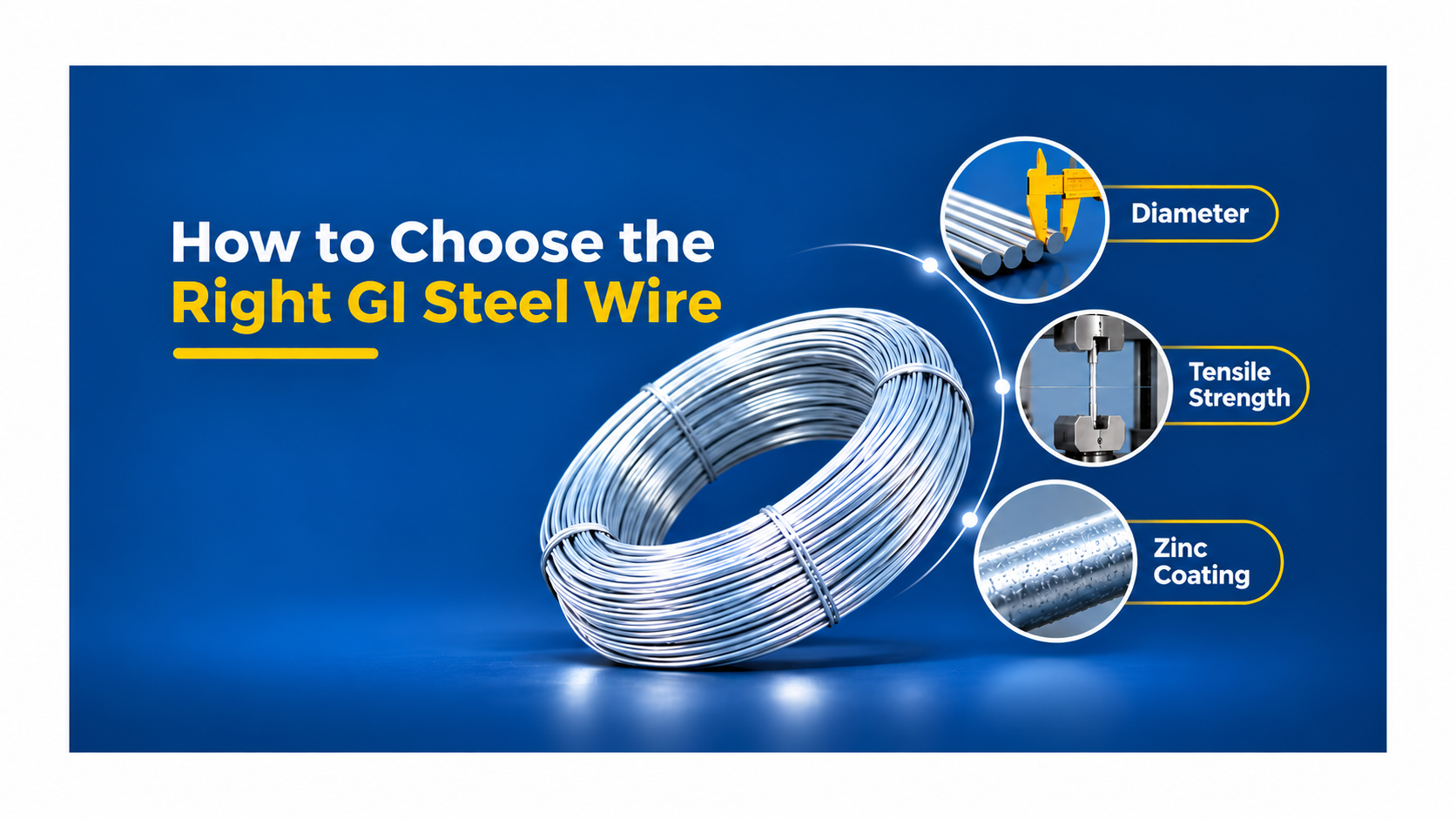
In this guide, we explain how to choose the right GI steel wire by evaluating its three most important characteristics: diameter, tensile strength, and zinc coating.
What Is GI Steel Wire?
GI steel wire, also known as galvanised steel wire, is a steel wire protected with a layer of zinc through a galvanisation process. The zinc coating acts as a barrier against moisture and environmental exposure while also providing sacrificial corrosion protection.
The right product depends on the intended use, required mechanical properties, environmental conditions, and product specifications.
1. Choose the Right GI Steel Wire Diameter
Wire diameter is one of the first specifications buyers should evaluate. It refers to the thickness of the wire and is generally measured in millimeters (mm).
The diameter influences the wire's weight, handling characteristics, flexibility, and mechanical performance. Selecting an unsuitable diameter can affect the performance of the finished product.
Why Does Wire Diameter Matter?
Different applications require different wire thicknesses.
Thinner GI wire: May be suitable for selected binding, tying, and light-duty applications.
Medium-diameter GI wire: Can be used in various fencing, mesh, and general-purpose applications, depending on the required strength.
Thicker GI wire: May be preferred for demanding fencing, industrial mesh, and selected support-related applications.
The actual suitability depends on the wire grade, tensile strength, coating, and finished product design.
How to Select the Correct Diameter
Consider these factors before selecting the wire diameter:
Application requirements: Identify whether the wire will be used for binding, fencing, mesh manufacturing, or another industrial purpose.
Required strength: Consider the mechanical load and stress the wire will experience during installation and operation.
Flexibility: Applications involving bending, twisting, or tying may require a diameter that offers suitable flexibility.
Manufacturing requirements: Wire mesh and fencing manufacturers should consider the required mesh design, opening dimensions, and production process.
Dimensional consistency: Ensure that the actual wire diameter remains within the specified tolerance throughout the supplied coil.
Always confirm the nominal diameter and permissible dimensional variation before placing an order.
For available product options and specifications, explore GI steel wire products here.
2. Understand the Tensile Strength of GI Steel Wire
Tensile strength is another important specification when choosing GI steel wire. It indicates the maximum tensile stress a wire can withstand before breaking during a tensile test.
It is generally expressed in megapascals (MPa) or newtons per square millimeter (N/mm²).
The required tensile strength varies depending on the intended application. A wire used for general-purpose binding may have different mechanical requirements from one used in high-tension fencing or industrial mesh.
Why Is Tensile Strength Important?
The tensile strength of GI steel wire influences its ability to withstand pulling forces and mechanical stress.
A wire with insufficient tensile strength may break under the expected load. On the other hand, selecting a wire with unnecessarily high tensile strength may increase costs or make it less suitable for applications requiring greater flexibility.
Other mechanical properties, particularly elongation, should also be considered.
Factors to Consider When Selecting Tensile Strength
Application load: Understand the amount of tension or pulling force the wire will experience.
Flexibility requirements: Applications involving repeated bending or twisting may require an appropriate balance between strength and elongation.
Installation conditions: Consider how the wire will be handled, stretched, tied, or incorporated into the finished product.
Finished product design: For fencing and mesh manufacturing, evaluate the mechanical requirements of the complete product rather than selecting wire based on tensile strength alone.
Testing consistency: Request relevant tensile test results to confirm that the supplied wire meets the specified requirements.
Selecting the right tensile strength helps achieve a balance between mechanical performance, flexibility, and durability.
3. Evaluate the Zinc Coating Quality
The zinc coating is what gives GI steel wire its improved corrosion resistance. However, the effectiveness of this protection depends on the coating's thickness, uniformity, and adhesion.
A wire with inadequate or inconsistent galvanization may experience premature corrosion, particularly when exposed to moisture and demanding environmental conditions.
What Is Zinc Coating in GI Steel Wire?
During galvanization, a protective zinc layer is applied to the surface of steel wire. This layer helps prevent direct exposure of the steel to corrosive elements.
Zinc also provides sacrificial protection. If the coating is locally damaged, zinc can corrode preferentially to the underlying steel under suitable conditions.
The amount of zinc coating is commonly specified by coating mass, expressed in grams per square meter (g/m²), or by coating thickness, expressed in micrometers (µm), depending on the applicable specification.
How to Choose the Right Zinc Coating
The required coating depends on the operating environment and expected service life.
Indoor applications: May require a different coating specification from products exposed continuously to outdoor conditions.
Outdoor fencing: Requires consideration of rainfall, humidity, and prolonged environmental exposure.
Coastal environments: May require enhanced corrosion protection because of more aggressive atmospheric conditions.
Industrial environments: Chemical exposure and other contaminants should be considered when determining the appropriate coating.
Soil-contact applications: Require careful evaluation of soil conditions and corrosion risks.
Important Zinc Coating Quality Checks
Before purchasing GI steel wire, evaluate:
Zinc coating mass or thickness.
Uniformity of the coating across the wire surface.
Adhesion of the zinc coating.
Surface finish and visible defects.
Consistency between production batches.
A suitable zinc coating specification helps improve corrosion protection and supports the expected service life of the finished product.
4. Hot-Dip vs Electro-Galvanized Steel Wire: Which Should You Choose?
Understanding the difference between galvanization processes can help buyers select the appropriate GI steel wire.
Parameter | Hot-Dip Galvanized Wire | Electro-galvanized Wire |
Coating process | Immersion in molten zinc | Electrochemical zinc deposition |
Zinc coating | Generally thicker | Generally thinner |
Corrosion protection | Often suitable for more demanding exposure | Depends on coating specification and environment |
Surface finish | May have a more noticeable coating texture | Generally smoother and more uniform |
Common considerations | Coating mass and uniformity | Coating thickness and coverage |
Hot-dip galvanised wire is often preferred when greater corrosion protection is required, particularly for outdoor applications. Electro-galvanized wire may be suitable for selected applications where a thinner coating meets the requirements.
The final choice should be based on the specified zinc coating and expected operating conditions rather than the galvanization method alone.
5. Match GI Steel Wire Specifications to the Application
A reliable selection process starts by understanding where and how the wire will be used.
Application | Important Selection Factors |
Construction binding | Suitable diameter, flexibility, and handling characteristics |
Chain-link fencing | Diameter, tensile strength, and zinc coating |
Welded wire mesh | Dimensional consistency, tensile properties, and coating quality |
Gabion baskets | Mechanical strength, mesh design, and corrosion protection |
Industrial applications | Application-specific diameter, tensile strength, and coating requirements |
For a deeper understanding of how GI steel wire is used in construction, its practical benefits, and important selection considerations, explore our guide on GI Steel Wire in Construction. For example, fencing manufacturers may prioritize tensile strength and corrosion resistance, while buyers sourcing wire for tying applications may place greater emphasis on flexibility and handling.
Material selection is equally important in other construction applications. Explore how concrete reinforcing fibers for construction applications help improve concrete durability, control shrinkage cracking, and enhance performance in suitable concrete mixes.
These fibers and GI steel wire serve different purposes and should be selected according to their respective application requirements.
6. Check Manufacturing Quality Before Purchasing
Even when the diameter, tensile strength, and zinc coating specifications are correct, inconsistent manufacturing quality can affect the finished product.
Before finalizing a purchase, consider evaluating the following:
Diameter consistency: Check whether the wire maintains uniform thickness throughout the coil.
Tensile strength: Verify that the mechanical properties meet the required specifications.
Coating uniformity: Inspect the zinc coating for consistent coverage.
Coating adhesion: Ensure that the zinc layer adheres properly to the steel surface.
Surface finish: Check for visible defects, irregularities, and coating damage.
Batch consistency: Compare product specifications and test results across different production batches.
Request product specifications and relevant quality test reports from the manufacturer. Choosing a supplier with established manufacturing and quality-control procedures helps support consistent product performance.
Beyond galvanised steel products, manufacturers also use synthetic fibres for industrial and construction applications, where specific material properties such as strength, durability, and chemical resistance are required.
Common Mistakes to Avoid When Buying GI Steel Wire
Buyers sometimes focus on price or a single specification when selecting galvanized steel wire. This can lead to unsuitable material selection and additional costs.
Avoid these common mistakes:
Choosing the wrong diameter: Selecting wire based only on availability instead of application requirements can affect performance.
Ignoring tensile strength: The wire may not withstand the mechanical stress expected during use.
Overlooking zinc coating quality: An inadequate coating can reduce corrosion protection.
Comparing prices without specifications: Two GI wires may have different diameters, tensile properties, and coating levels despite similar descriptions.
Ignoring manufacturing consistency: Variations between batches can affect production and finished-product quality.
A complete specification-based evaluation is more reliable than choosing GI steel wire based on price alone.
Conclusion
Choosing the right GI steel wire requires careful evaluation of three essential factors: diameter, tensile strength, and zinc coating. Diameter determines the wire's thickness and influences its handling and mechanical performance. Tensile strength indicates its ability to withstand pulling forces, while the zinc coating provides protection against corrosion.
Explore GI steel wire specifications and products at Shanthi Industries to find suitable wire solutions for your application. Contact the team to discuss your requirements and identify the appropriate product specifications.
Frequently Asked Questions (FAQs)
1. How do I choose the right diameter for GI steel wire?
The correct diameter depends on the intended application, required mechanical strength, flexibility, and finished product design. Thinner wire may suit selected binding applications, while thicker wire may be needed for certain fencing and mesh products.
2. What is the ideal tensile strength for GI steel wire?
There is no single ideal tensile strength for every application. The required value depends on the wire's intended use, mechanical loading, flexibility requirements, and product specifications. Always confirm the tensile strength required for the finished application.
3. Why is zinc coating important in GI steel wire?
Zinc coating protects the underlying steel from corrosion by acting as a barrier and providing sacrificial protection. The appropriate coating mass or thickness helps determine the wire's suitability for different environmental conditions.
4. Is hot-dip galvanised wire better than electro-galvanised wire?
Hot-dip galvanised wire generally has a thicker zinc coating and is often preferred for applications requiring greater corrosion protection. Electro-galvanized wire typically has a thinner coating and may be suitable for selected applications with less demanding exposure conditions.
5. What should I check before purchasing GI steel wire?
Check the wire diameter, tensile strength, zinc coating mass or thickness, coating uniformity, adhesion, surface finish, and manufacturing consistency. Request relevant product specifications and quality test reports to verify that the wire meets your application requirements.