In industries where precision, durability, and performance are critical, monofilament yarn plays a vital role. From industrial fabrics and filtration systems to fishing lines, agricultural nets, brushes, and technical textiles, the quality of monofilament yarn directly impacts the reliability of the final product. This is why understanding the quality testing standards for monofilament yarn is essential for manufacturers, buyers, and end-users alike.
High-quality monofilament yarn is not defined solely by its material composition. It must consistently meet strict performance requirements related to strength, diameter, flexibility, durability, and environmental resistance. To ensure these characteristics, manufacturers rely on a series of standardized testing procedures that evaluate the yarn’s physical and mechanical properties.
Why Quality Testing Standards for Monofilament Yarn Matter
Quality testing serves as the foundation of a reliable manufacturing process. Even minor variations in yarn diameter or tensile strength can significantly affect the performance of the finished product.
The primary objectives of quality testing standards for monofilament yarn include:
- Ensuring product consistency across production batches
- Verifying compliance with industry requirements
- Improving product durability and performance
- Reducing material waste and production defects
- Building customer confidence and trust
Manufacturers who implement rigorous testing standards can deliver yarn that meets precise specifications while maintaining consistent quality over time. In fact, proper testing procedures directly contribute to how monofilament yarn improves product durability, ensuring that end products maintain their strength and functionality even in demanding environments.
Key Quality Testing Standards for Monofilament Yarn
Several testing parameters are used to evaluate monofilament yarn quality. Each test focuses on a specific property that contributes to overall performance.
1. Tensile Strength Testing in Quality Testing Standards for Monofilament Yarn
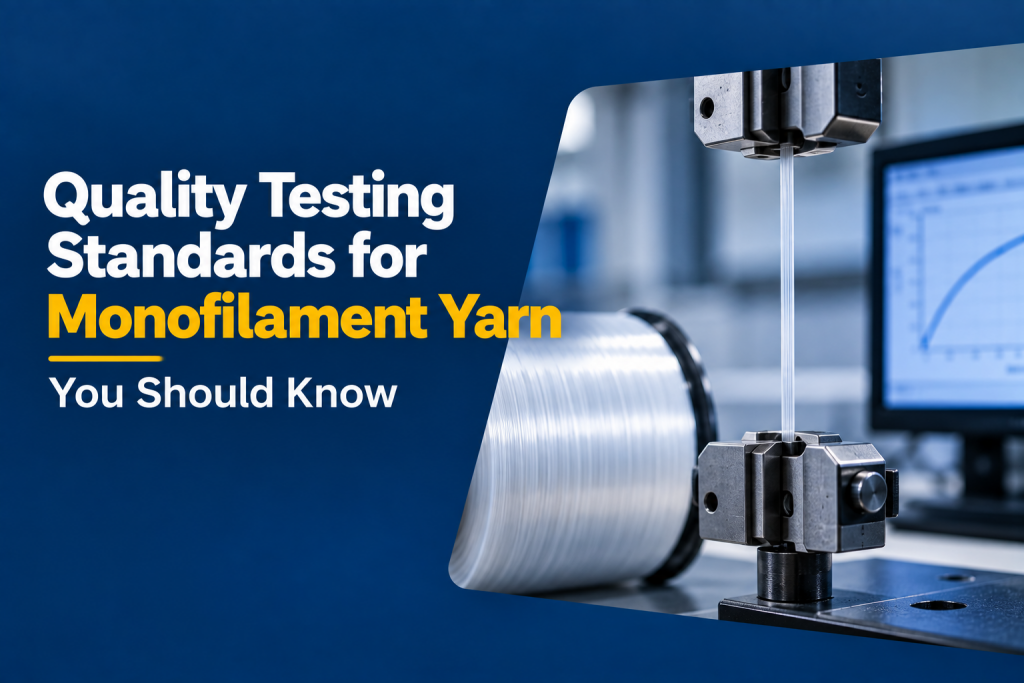
Tensile strength is one of the most important measurements in monofilament yarn production. This test determines the maximum force the yarn can withstand before breaking.
A tensile testing machine applies increasing force to the yarn until failure occurs. The results help manufacturers determine whether the yarn meets the required strength specifications for its intended application.
Industries such as fishing, filtration, and industrial textiles often require high-tensile-strength monofilament yarn to ensure long-term reliability under stress. These performance levels are achievable through the precision engineering in monofilament manufacturing, where advanced production controls help maintain consistent yarn properties.
Benefits of tensile strength testing include:
- Improved product durability
- Enhanced load-bearing performance
- Better resistance to breakage during use
- Consistent quality across production batches
2. Diameter Consistency Testing in Quality Testing Standards for Monofilament Yarn
Diameter uniformity is critical in monofilament yarn manufacturing. Even slight variations can affect weaving performance, product appearance, and mechanical properties.
Precision measuring instruments such as laser gauges and micrometers are commonly used to verify diameter consistency throughout the production process.
Consistent diameter ensures:
- Smooth processing during weaving and knitting
- Uniform product quality
- Better mechanical performance
- Reduced manufacturing defects
For industries requiring high precision, diameter consistency is often considered one of the most important quality testing standards for monofilament yarn.
3. Elongation Testing in Quality Testing Standards for Monofilament Yarn
Elongation testing measures how much a monofilament yarn can stretch before it breaks. This property is especially important in applications where flexibility and shock absorption are required.
The test is usually performed alongside tensile strength testing and is expressed as a percentage of the yarn’s original length.
Proper elongation characteristics help ensure:
- Better flexibility
- Resistance to sudden impacts
- Improved handling properties
- Enhanced product lifespan
The ideal elongation value varies depending on the specific application and material type.
Advanced Quality Testing Standards for Monofilament Yarn
Beyond basic mechanical testing, manufacturers often conduct advanced evaluations to ensure the yarn performs effectively under challenging operating conditions.
1. Abrasion Resistance Testing in Quality Testing Standards for Monofilament Yarn
Many monofilament yarn applications involve continuous friction and wear. Abrasion resistance testing evaluates how well the yarn withstands repeated surface contact.
This test is particularly important for:
- Industrial brushes
- Conveyor systems
- Agricultural nets
- Filtration products
A yarn with high abrasion resistance can maintain its performance over extended periods, reducing maintenance and replacement costs. This is one reason for monofilament yarn for industrial usage, where materials are expected to withstand continuous operational stress.
2. Thermal Stability Testing in Quality Testing Standards for Monofilament Yarn
Monofilament yarn is frequently exposed to elevated temperatures during manufacturing and end-use applications.
Thermal stability testing measures the yarn’s ability to maintain its structural integrity under varying temperature conditions.
Manufacturers assess factors such as the following:
- Melting point
- Heat shrinkage
- Dimensional stability
- Performance at high temperatures
Thermal testing is essential for applications involving industrial processing environments and technical textiles.
3. Chemical Resistance Testing in Quality Testing Standards for Monofilament Yarn
Many industrial environments expose yarn to chemicals, solvents, oils, and cleaning agents. Chemical resistance testing helps determine how well the yarn maintains its properties when exposed to these substances.
The test evaluates:
- Strength retention
- Surface integrity
- Dimensional stability
- Resistance to degradation
When combined with rigorous quality testing, these characteristics contribute to the production of durable and versatile monofilament yarn suitable for a wide range of industrial and commercial applications.
How Manufacturers Implement Quality Testing Standards for Monofilament Yarn
Modern manufacturers integrate testing throughout the production process rather than relying solely on final inspections.
Quality control generally occurs at three key stages:
1. Raw Material Inspection
The process begins by evaluating incoming polymer materials to ensure they meet required specifications.
Checks may include:
- Material purity
- Moisture content
- Melt flow characteristics
- Chemical composition
2. In-Process Quality Monitoring
During extrusion and drawing operations, manufacturers continuously monitor production parameters.
These include:
- Diameter consistency
- Process temperature
- Tension control
- Surface quality
Real-time monitoring helps identify potential issues before they affect large production batches.
3. Final Product Validation
Finished yarn undergoes comprehensive testing to verify compliance with established quality testing standards for monofilament yarn.
The final inspection may include:
- Tensile strength analysis
- Elongation testing
- Diameter verification
- Surface inspection
- Packaging quality checks
This multi-stage approach helps ensure every batch meets customer expectations.
International Standards Used in Quality Testing Standards for Monofilament Yarn
Manufacturers often follow internationally recognized standards to ensure product reliability and global acceptance.
Some commonly referenced standards include:
ASTM Standards
The American Society for Testing and Materials (ASTM) provides widely recognized testing procedures for synthetic fibers and monofilament materials.
ASTM standards help ensure:
- Consistent testing methodologies
- Reliable performance evaluation
- Industry-wide quality benchmarks
ISO Standards
The International Organization for Standardization (ISO) establishes globally accepted testing frameworks for textile and polymer products. Compliance with these standards demonstrates a manufacturer’s commitment to delivering dependable products while supporting sustainable manufacturing practices. As industries increasingly prioritize environmental responsibility, many manufacturers are also exploring sustainable and eco-friendly monofilament yarn solutions without compromising quality or performance.
Conclusion
Understanding quality testing standards for monofilament yarn is essential for anyone involved in selecting, manufacturing, or using monofilament products. From tensile strength and elongation to diameter consistency, abrasion resistance, and thermal stability, each test plays a crucial role in ensuring performance and reliability.
At Shanthi Industries, quality remains at the core of every manufacturing process. By following stringent testing procedures and maintaining high production standards, we ensure that our monofilament yarn solutions consistently meet the evolving needs of modern industries.
Frequently Asked Questions (FAQs)
1. What are the most important quality testing standards for monofilament yarn?
The most important quality testing standards for monofilament yarn include tensile strength testing, diameter consistency testing, elongation testing, abrasion resistance testing, thermal stability testing, and chemical resistance testing. These tests help ensure the yarn performs reliably in its intended application.
2. Why is tensile strength testing important in monofilament yarn manufacturing?
Tensile strength testing determines the maximum load a monofilament yarn can withstand before breaking. This test is critical because it ensures the yarn has the required strength for applications such as fishing nets, filtration fabrics, industrial brushes, and technical textiles.
3. How does diameter consistency affect monofilament yarn quality?
Diameter consistency directly impacts the performance and appearance of the final product. Uniform yarn diameter ensures smooth weaving, better fabric quality, consistent mechanical properties, and fewer manufacturing defects, making it a key aspect of quality testing standards for monofilament yarn.
4. Which international standards are commonly used for testing monofilament yarn?
Manufacturers typically follow internationally recognized standards such as ASTM (American Society for Testing and Materials) and ISO (International Organization for Standardization). These standards provide standardized testing methods to ensure product quality, reliability, and global compliance.
5. How can buyers verify whether a manufacturer follows quality testing standards for monofilament yarn?
Buyers can assess a manufacturer by reviewing their quality control processes, testing certifications, in-house laboratory capabilities, compliance with ASTM or ISO standards, and documentation of test reports. Choosing a manufacturer with robust testing procedures helps ensure consistent product quality and performance.
CTA
You can always reach out to Shanthi Industries. We’ll help you sort through the options and get the right match.
Contact us: +91 99022 98755
Email id: info@shanthiindustries.com