Industrial filtration plays a critical role in maintaining product quality, protecting equipment, and ensuring operational efficiency across manufacturing sectors. Whether it is water treatment, food processing, pharmaceuticals, chemical production, or mining, selecting the right filtration material significantly impacts performance and operational costs.
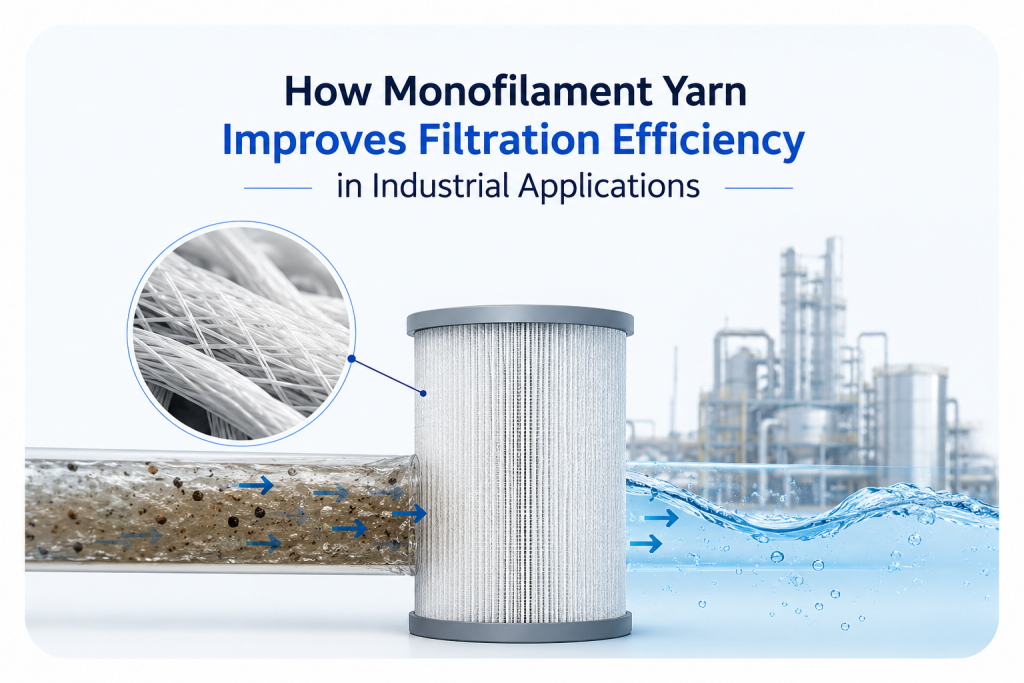
One material that has consistently delivered reliable filtration performance is monofilament yarn. Due to its uniform structure, exceptional strength, and chemical resistance, monofilament yarn improves filtration efficiency by providing precise filtration, longer service life, and consistent flow rates across demanding industrial environments.
In this article, we’ll explore how monofilament yarn works, why industries prefer it for filtration systems, and how it enhances filtration performance across various applications.
Why Monofilament Yarn Improves Filtration Efficiency Better Than Conventional Materials
Unlike multifilament yarns that consist of multiple tiny fibers twisted together, monofilament yarn is manufactured using a single continuous filament. This smooth and uniform construction creates consistent pore sizes when woven into filtration fabrics. The result is improved particle retention while maintaining optimal fluid flow.
Some of the key characteristics that make monofilament yarn ideal for industrial filtration include:
- Uniform diameter throughout the yarn
- Smooth surface that minimizes clogging
- Excellent tensile strength
- High abrasion resistance
- Chemical and moisture resistance
- Thermal stability
- Long operational lifespan
These features collectively explain why monofilament yarn improves filtration efficiency across multiple industrial processes.
How Monofilament Yarn Improves Filtration Efficiency Through Precision Filtration
Precision is one of the most important factors in industrial filtration.
The consistency of monofilament yarn begins with advanced manufacturing techniques. The precision engineering on monofilament ensures uniform filament diameters, allowing filtration fabrics to maintain accurate pore sizes and deliver repeatable filtration performance.
1. Accurate Particle Separation
Uniform pore sizes help capture contaminants more effectively while allowing the desired liquid or gas to pass through with minimal resistance.
2. Stable Flow Rate
Because the filter openings remain consistent, fluid flow remains predictable, reducing pressure variations during operation.
3. Reduced Product Loss
Precision filtration minimizes valuable material loss during processing, making production more economical.
Industries that demand highly controlled filtration often rely on monofilament-based filter fabrics because they deliver repeatable and dependable performance.
Lower Clogging Means Higher Productivity
One major reason monofilament yarn improves filtration efficiency is its smooth surface. Unlike multifilament yarn, which contains numerous microscopic fibers capable of trapping debris within the yarn itself, monofilament yarn has a non-porous exterior.
This provides several operational benefits:
- Less dirt accumulation
- Easier cleaning
- Faster backwashing
- Reduced maintenance frequency
- Longer filter life
Because contaminants remain on the filter surface rather than penetrating deep into the fabric, cleaning becomes significantly more effective. For industries operating continuous filtration systems, this translates into reduced downtime and improved productivity.
Chemical Resistance Enhances Filtration Performance
Many industrial filtration processes involve aggressive chemicals, solvents, oils, acids, or alkaline solutions.
Monofilament yarn can be manufactured using polymers such as:
- Nylon yarn
- Polyester yarn
- Polypropylene
- Polyethylene yarn
Each material offers different levels of chemical resistance suitable for specific industrial environments.
This resistance allows filtration fabrics to maintain their structural integrity even after prolonged exposure to harsh operating conditions.
As a result, monofilament yarn improves filtration efficiency without frequent replacement or performance degradation.
Excellent Mechanical Strength for Continuous Operations
Industrial filtration systems often operate under continuous pressure and abrasive conditions. Filtration fabrics must resist stretching, tearing, and wear over extended periods.
Manufacturers also recognize monofilament yarn improves product durability and performance because its high tensile strength helps filtration fabrics maintain their structure even after repeated cleaning cycles and prolonged use.
Its mechanical advantages include the following:
- High tensile strength
- Excellent dimensional stability
- Superior abrasion resistance
- Long service life
- Consistent filtration accuracy
These properties enable filters to perform reliably under demanding industrial conditions while reducing maintenance and replacement costs.
Industries Where Monofilament Yarn Improves Filtration Efficiency
The growing applications of monofilament yarn demonstrate its versatility across numerous industrial sectors where precise filtration is essential.
1. Water Treatment
Water treatment facilities use monofilament filter media for:
- Sludge dewatering
- Wastewater filtration
- Sand filtration
- Industrial water recycling
Its durability and easy cleaning make it ideal for continuous operations.
Food manufacturers require hygienic filtration materials that deliver consistent performance.
2. Food and Beverage Processing
Applications include:
- Sugar filtration
- Juice processing
- Brewing
- Dairy filtration
- Edible oil filtration
Monofilament fabrics support efficient filtration while maintaining product quality.
3. Chemical Manufacturing
Chemical plants handle corrosive fluids that require chemically resistant filtration materials.
Monofilament yarn performs well in:
- Resin filtration
- Polymer production
- Solvent filtration
- Chemical separation processes
4. Pharmaceutical Industry
Pharmaceutical manufacturing depends on precision filtration for maintaining product purity.
Monofilament fabrics assist in:
- Process filtration
- Sterile liquid filtration
- Intermediate product separation
- Laboratory filtration equipment
5. Mining and Mineral Processing
Mining operations use filtration systems for separating solids from liquids.
Applications include:
- Slurry filtration
- Mineral recovery
- Tailings management
- Dewatering systems
The abrasion resistance of monofilament yarn makes it particularly suitable for these harsh environments.
How Monofilament Filter Fabrics Reduce Operating Costs
While the initial investment in premium filtration media may be higher, the long-term savings are substantial.
Because monofilament yarn improves filtration efficiency, manufacturers benefit from:
1. Longer Service Life
Durable yarns withstand repeated cleaning cycles without losing filtration performance.
2. Lower Maintenance Costs
Smooth surfaces reduce clogging, decreasing maintenance requirements.
3. Reduced Downtime
Long-lasting filter media means fewer replacements and uninterrupted production.
4. Improved Energy Efficiency
Stable flow rates reduce pressure drops, lowering energy consumption within filtration systems.
5. Better Product Quality
Consistent filtration minimizes contamination, reducing rejected products and improving process reliability.
Choosing the Right Monofilament Yarn for Filtration Applications
Not every filtration process requires the same type of yarn.Several factors should be evaluated before selecting filtration media:
1. Material Type
Choose between nylon, polyester, polypropylene, or polyethylene depending on chemical compatibility.
2. Filtration Micron Rating
Select the appropriate pore size based on particle size requirements.
3. Operating Temperature
Ensure the yarn can tolerate process temperatures.
4. Chemical Exposure
Evaluate resistance to acids, alkalis, solvents, and oils.
5. Mechanical Stress
Consider pressure, abrasion, and cleaning frequency.
Working with an experienced monofilament yarn manufacturer ensures the filtration media is tailored to your industrial process for maximum efficiency.
Why Manufacturers Continue to Choose Monofilament Yarn
Industrial filtration demands materials that combine precision, durability, and operational reliability. As production standards become more stringent, businesses need filtration solutions that deliver consistent results while minimizing maintenance and downtime.
Manufacturers continue to understand monofilament is ideal for high-performance industrial usage because it combines dimensional stability, exceptional strength, chemical resistance, and precision filtration into a single solution.
Whether used in water treatment, food processing, pharmaceuticals, chemical manufacturing, or mining, monofilament yarn improves filtration efficiency by maintaining consistent pore structures, reducing clogging, extending filter life, and supporting continuous production. Investing in high-quality monofilament yarn not only improves filtration performance but also contributes to lower maintenance costs, enhanced product quality, and greater operational efficiency across modern industrial applications.
Frequently Asked Questions (FAQs)
1. How does monofilament yarn improve filtration efficiency?
Monofilament yarn improves filtration efficiency by creating uniform pore sizes, reducing clogging, maintaining consistent flow rates, and offering superior durability during continuous industrial filtration processes.
2. Which industries commonly use monofilament yarn for filtration?
Industries such as water treatment, food processing, pharmaceuticals, chemical manufacturing, mining, textile processing, and wastewater management widely use monofilament yarn for efficient filtration.
3. Why is monofilament yarn better than multifilament yarn for filtration?
Monofilament yarn has a smooth single-filament structure that minimizes dirt retention, simplifies cleaning, provides more accurate filtration, and offers longer service life compared to multifilament yarn.
4. Which materials are used to manufacture monofilament filtration yarn?
Common materials include nylon, polyester, polypropylene, and polyethylene, each selected based on filtration requirements, chemical compatibility, and operating conditions.
5. How do I choose the right monofilament yarn for industrial filtration?
The ideal monofilament yarn depends on factors such as filtration micron rating, operating temperature, chemical exposure, mechanical stress, and the specific industrial application. Working with an experienced manufacturer helps ensure the best selection for optimal filtration performance
CTA
You can always reach out to Shanthi Industries. We’ll help you sort through the options and get the right match.
Contact us: +91 99022 98755
Email id: info@shanthiindustries.com