
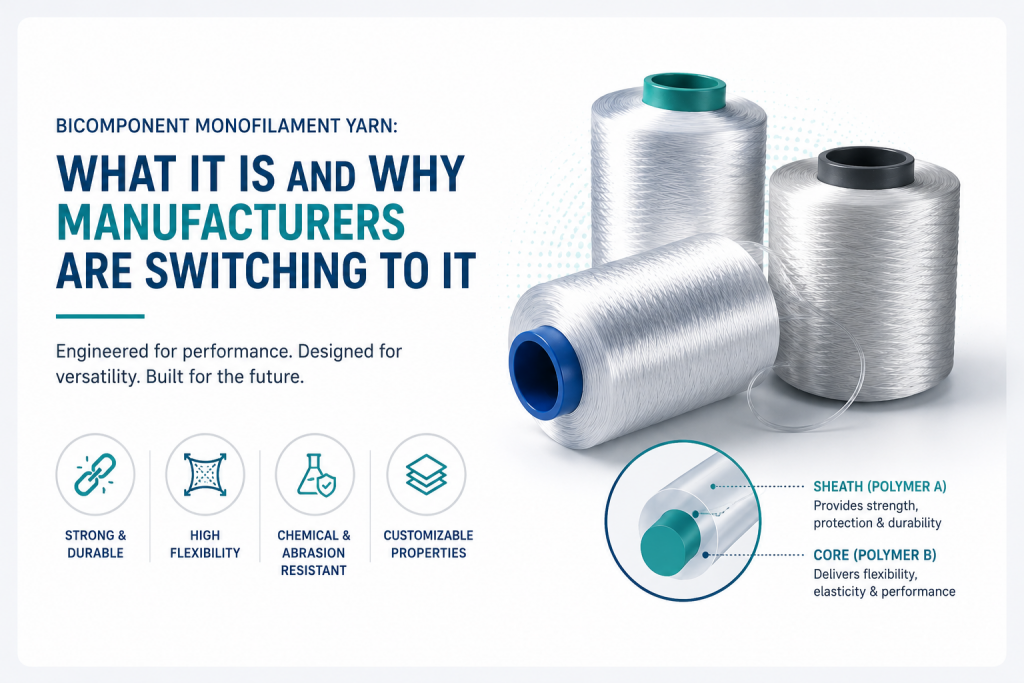
In today’s competitive manufacturing landscape, industries are constantly seeking materials that offer better performance, durability, and cost efficiency. One innovation that has gained significant attention in recent years is bicomponent monofilament yarn. This advanced yarn technology combines the properties of two different polymers into a single filament, creating a product that delivers enhanced functionality compared to traditional monofilament yarn.
From industrial fabrics and filtration systems to automotive applications and technical textiles, manufacturers are increasingly adopting bicomponent monofilament yarn to improve product quality and production efficiency. But what exactly is bicomponent monofilament yarn, and why is it becoming the preferred choice across industries?
Let’s explore.
What Is Bicomponent Monofilament Yarn?
Bicomponent monofilament yarn is a specialized type of monofilament yarn produced by combining two distinct polymer materials into a single filament structure. Unlike conventional monofilament yarns made from a single polymer, bicomponent yarns leverage the unique properties of two polymers to achieve superior performance characteristics.
The two polymers are extruded simultaneously and arranged in specific configurations, such as the following:
- Core-sheath structure
- Side-by-side structure
- Segmented pie structure
- Islands-in-the-sea structure
Each configuration is designed to deliver specific functional benefits depending on the intended application.
How Bicomponent Monofilament Yarn Is Manufactured
The production of bicomponent monofilament yarn involves advanced extrusion technology that precisely combines two polymers during the manufacturing process.
The process typically includes:
- Selection of compatible polymers
- Melting and preparation of polymer materials
- Simultaneous extrusion through specialized spinnerets
- Controlled cooling and solidification
- Drawing and stretching for strength enhancement
- Winding and quality inspection
This sophisticated manufacturing technique ensures uniformity, consistency, and optimal performance in the final product.
Key Features of Bicomponent Monofilament Yarn
The growing popularity of bicomponent monofilament yarn can be attributed to its unique characteristics that outperform conventional single-polymer monofilaments. Many of these advantages build upon the core benefits discussed in our article on Benefits of Using Monofilament Yarn.
1. Enhanced Strength and Durability
By combining polymers with complementary properties, bicomponent monofilament yarn offers exceptional tensile strength and resistance to wear and tear. This makes it ideal for demanding industrial environments where durability is essential.
Manufacturers looking to improve product longevity can also explore how Monofilament Yarn Improves Product Durability across various industrial applications.
2. Improved Flexibility
Manufacturers can achieve greater flexibility without sacrificing strength. This balance allows the yarn to perform effectively in applications requiring repeated bending, stretching, or movement.
3. Better Thermal Performance
Certain bicomponent structures are designed to withstand higher temperatures or provide controlled thermal bonding. This feature is particularly valuable in automotive, filtration, and technical textile applications.
4. Superior Chemical Resistance
The ability to combine polymers with different chemical resistance properties enhances the yarn’s performance in harsh environments exposed to oils, solvents, moisture, or industrial chemicals.
5. Customized Functional Properties
One of the biggest advantages of bicomponent monofilament yarn is the ability to tailor its characteristics according to specific application requirements.
Manufacturers can customize:
- Stiffness
- Elasticity
- Surface properties
- Heat resistance
- Bonding behavior
- Abrasion resistance
Why Manufacturers Are Switching to Bicomponent Monofilament Yarn
As industries focus on improving product performance and operational efficiency, many manufacturers are replacing traditional monofilament yarns with bicomponent alternatives.
When evaluating material options, understanding the differences between Polyester vs Nylon Monofilament Yarn can help businesses select the most suitable solution for their application.
1. Bicomponent Monofilament Yarn Delivers Higher Performance
Modern industrial applications require materials that can withstand increasingly demanding conditions. Bicomponent monofilament yarn offers enhanced mechanical and physical properties that help manufacturers meet these requirements.
Products made using bicomponent yarn often exhibit the following:
- Longer service life
- Better dimensional stability
- Improved resistance to environmental factors
- Consistent performance under stress
2. Reduced Material Costs
Although bicomponent monofilament yarn may involve advanced manufacturing processes, it can contribute to long-term cost savings.
Manufacturers benefit from:
- Reduced maintenance requirements
- Lower replacement frequency
- Improved product lifespan
- Enhanced production efficiency
These advantages often outweigh the initial investment.
3. Greater Design Flexibility
The ability to combine different polymer characteristics allows product designers to create innovative solutions that were difficult or impossible with conventional yarns.
This flexibility enables manufacturers to develop products tailored to specific customer requirements and market demands.
4. Improved Sustainability
Sustainability has become a major priority across industries. Bicomponent monofilament yarn can support sustainability goals by improving product durability and reducing material waste.
Longer-lasting products contribute to:
- Lower resource consumption
- Reduced replacement cycles
- Improved environmental performance
Many manufacturers view bicomponent yarn technology as an important step toward more sustainable production practices.
Applications of Bicomponent Monofilament Yarn
The versatility of bicomponent monofilament yarn has led to its adoption across numerous industries.
1. Industrial Filtration
Filtration systems require materials that can withstand challenging operating conditions while maintaining consistent performance.
It is widely used in the following:
- Air filtration systems
- Liquid filtration media
- Industrial filter fabrics
- Dust collection systems
Its role in precision filtration is similar to applications in monofilament yarn in medical grade.
2. Automotive Industry
Automotive manufacturers rely on advanced materials to improve vehicle performance, durability, and safety.
Applications include:
- Automotive textiles
- Reinforcement materials
- Interior components
- Technical fabrics
3. Agricultural Textiles
Agricultural products benefit from the durability and weather resistance offered by bicomponent monofilament yarn.
Common uses include:
- Crop protection nets
- Shade nets
- Agricultural screens
- Soil stabilization fabrics.
4. Technical and Industrial Fabrics
The yarn is also extensively used in:
- Conveyor belts
- Mesh fabrics
- Industrial screens
- Geotextiles
- Safety textiles
Its adaptability makes it a preferred material for numerous specialized applications.
The Future of Bicomponent Monofilament Yarn
As industries continue to demand smarter, stronger, and more sustainable materials, the role of bicomponent monofilament yarn is expected to grow significantly.
This trend aligns with broader industry projections highlighted in Global Demand for Monofilament Yarn, where advanced monofilament solutions are expected to see strong market growth.
Conclusion
Bicomponent monofilament yarn represents a major advancement in monofilament technology. By combining two polymers into a single filament, manufacturers gain access to enhanced strength, flexibility, durability, chemical resistance, and thermal performance.
Businesses looking to improve product quality, reduce long-term costs, and stay ahead of industry trends are increasingly turning to bicomponent monofilament yarn as the material of choice for modern industrial applications. Get in touch with us today.
Frequently Asked Questions (FAQs)
1. What is bicomponent monofilament yarn?
Bicomponent monofilament yarn is a specialized yarn made by combining two different polymers into a single filament, providing enhanced strength, flexibility, and performance compared to conventional monofilament yarns.
2. What are the benefits of bicomponent monofilament yarn?
The key benefits include improved durability, better thermal resistance, enhanced chemical resistance, greater flexibility, and the ability to customize performance for specific applications.
3. Where is bicomponent monofilament yarn commonly used?
It is widely used in filtration systems, automotive textiles, industrial fabrics, agricultural nets, paper machine clothing, and various technical textile applications.
4. How is bicomponent monofilament yarn different from standard monofilament yarn?
Unlike standard monofilament yarn, which is made from a single polymer, bicomponent monofilament yarn combines two polymers to deliver multiple performance advantages in one filament.
5. Why are manufacturers switching to bicomponent monofilament yarn?
Manufacturers are adopting bicomponent monofilament yarn because it offers superior product performance, longer service life, improved efficiency, and greater design flexibility for modern industrial applications.